
School transport decisions often come down to price and availability. That works until you try to confirm what the operator is actually licensed to do.
For school trip minibus hire, the safety wins come from a few specific checks. You need the right operator licence, the right driver entitlement, and a maintenance system you can read in writing.
This guide from Essex Minibuses gives you a practical checklist for student transport. It covers home to school services, local Essex minibus hire, and coach hire for school trips across the home counties.
Key Takeaways
- Check the basics first. Look for DBS checked staff, safeguarding expectations, in date first aid, and minibus specific training such as MiDAS and PATS for SEND support roles.
- Verify the legal setup. Confirm the operator holds a PSV licence from the Traffic Commissioner or the correct Section 19 or Section 22 permit for not for profit operations.
- Ask for proof of a planned maintenance system. Daily walkaround checks, defect reporting, and a safety inspection interval matter. Many schools use 6 weekly inspections as a benchmark.
- Make seatbelts non-negotiable. Every passenger seat needs a working belt, a clear belt on rule, and a named adult to enforce it on every journey.
- For SEND journeys, confirm wheelchair access, clamp and restraint procedures, and that the operator can explain their risk assessment process clearly.
- Use reviews properly. Ask for recent school or council references you can call. Back those up with independent Google and Trustpilot reviews.
Why School Trip Minibus Hire Safety Matters?
A safe minibus service cuts risk for students, drivers, and schools. The difference rarely comes from one standout feature.
It comes from the operator’s system. Who they put behind the wheel, how they maintain vehicles, and how they manage behaviour on board all count.
If you arrange school coach hire or minibus hire across Essex, Hertfordshire, Surrey, or Berkshire, the trip must also be lawful. The provider must operate under the right licence or permit. They must follow conduct rules that cover drivers, staff, and passengers.
Reliability matters too. Missed bookings can remove a service. Late arrivals can disrupt exam travel and time critical educational visits.
Key Factors to Check in a Safe Minibus Service for Students
Start with three areas: licensing, people, and vehicles.
- Licensing: confirm whether the operator holds a PSV operator licence, a Section 19 or Section 22 permit, or local taxi and private hire licensing.
- People: check DBS status, safeguarding expectations, and role specific training. Driver and passenger assistant are different jobs with different requirements.
- Vehicles: ask for a maintenance plan, daily walkaround check records, and safety features that match your group’s needs.
Essex Minibuses covers school trips, sports fixtures, airport runs, and educational visits. We apply the same checklist across all of them. The destination changes. The duty of care does not.
How to Verify Licences and Certifications?
Ask for documents you can read. Do not accept verbal assurances.
The Department for Education home to school statutory guidance states that bus and coach operators use a PSV operator’s licence. Not for profit organisations can use Section 19 or Section 22 permits instead, depending on how the service runs.
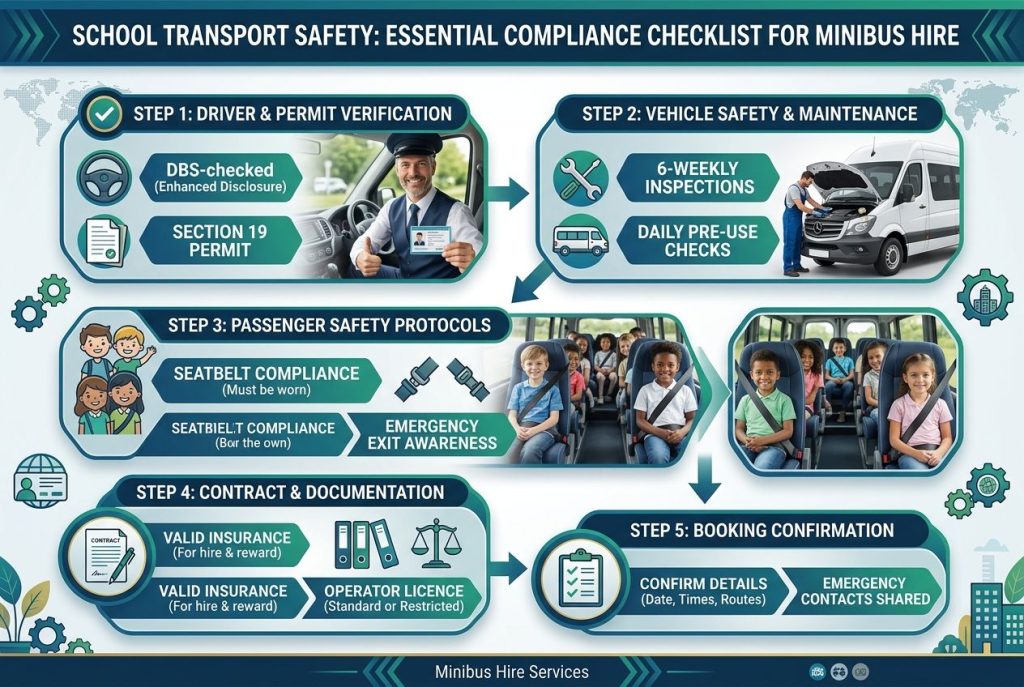
- Operator licence or permit: ask whether the service runs under a PSV operator licence or a Section 19 or Section 22 permit. Get a copy for your trip file.
- Driver entitlement: confirm the licence category fits the vehicle. D1 covers many minibuses. Hire and reward rules can change what the driver needs.
- Driver CPC for PCV work: where the journey counts as bus or coach work, check the driver holds a valid Driver Certificate of Professional Competence. GOV.UK states periodic Driver CPC requires 35 hours of training every 5 years.
- DBS evidence: ask what certificate type the operator uses for this role and how they keep it current. If they use the DBS Update Service, ask how often they run status checks.
- Insurance schedule: request the certificate and confirm it covers the work you book. This includes school transport, school trips, and any specialist journeys your group needs.
- Written safeguarding and passenger rules: ask for a copy you can share with staff, parents, and students. It should cover seatbelt and behaviour expectations.
What Qualifications Should Drivers Have?
At a minimum, drivers need the right vehicle entitlement, a vetting clearance for working around children, and training suited to your passenger group.
Schools often treat minibus specific training as a sign the operator takes safety seriously. This matters most for mixed groups and longer trips.
- DBS and safeguarding: the operator should explain what drivers do if a pupil discloses a safeguarding concern or if behaviour becomes unsafe during the journey.
- First aid: confirm who holds in date first aid training and what kit sits on board.
- MiDAS: the Minibus Driver Awareness Scheme raises driving standards. Many organisations treat it as a practical benchmark for school and community minibus work.
- PATS for assisted travel: where a passenger assistant supports students with SEND, look for Passenger Assistant Training Scheme training. This covers safe assistance, supervision, and emergency procedures.
For SEND journeys, ask who secures wheelchairs and who supervises the passenger area. Role separation matters. The driver must not manage mobility equipment and behaviour at the same time.
How Often Should Minibuses Be Maintained?
You need two things: a planned inspection schedule and written evidence that it runs.
The government Guide to Maintaining Roadworthiness sets out safety inspection expectations. Older passenger vehicles may need more frequent inspections. Vehicles and trailers aged 12 years and older typically need inspections at least every 6 weeks.
- Daily walkaround checks: ask for the operator’s walkaround checklist and a sample defect report. DVSA publishes guidance on what a PSV walkaround check should cover.
- Safety inspection interval: confirm the planned schedule. For many school contracts this is 6 weekly. Ask how they adjust it for higher mileage, harder routes, or older vehicles.
- Annual test and MOT history: ask what annual testing the vehicle type needs. Ask who reviews and signs off defects.
If you book a vehicle for a longer run including European travel, ask about contingency planning. You need a clear process for breakdown cover, replacement vehicles, and communication with the school.
Which Safety Features Should a Student Minibus Have?
The table below covers the must have safety features for student minibuses. It also shows the quickest way to verify each one before you book.
| Feature | Why It Matters | Practical Check |
| Seatbelts on all passenger seats | Belts reduce injury risk and help manage behaviour on school journeys. | Ask for a vehicle spec sheet. Confirm every passenger seat has a working belt. Check on the day. |
| Clear seatbelt enforcement plan | Belts only help when students wear them. | Agree who checks belts before moving off and after every stop. Put it in the trip brief. |
| Wheelchair access (ramp or lift) | Students using powered or manual wheelchairs need safe boarding and alighting. | Ask the operator to demonstrate the ramp or lift. Confirm it is maintained and tested. |
| Wheelchair restraints and occupant belts | Wheelchair users need securement that prevents movement during braking and cornering. | Ask who is trained to use clamps and restraints. Ask how they check the fit before the vehicle moves. |
| Accessible compliance (PSVAR where in scope) | Some services must meet accessibility requirements. Exemptions can be time limited. | Relevant home to school PSVAR exemptions currently run until 31 July 2026. Ask whether the vehicle is PSVAR compliant or running under an exemption. |
| Emergency equipment | A first aid kit, fire extinguisher, and warning triangle support a safer response if something goes wrong. | Ask to see the kit location. Check contents are in date before departure. |
| Driver daily defect reporting | Small faults grow into big faults when nobody records them. | Ask how drivers report defects and how quickly the maintenance team reviews and signs them off. |
| GPS tracking and journey updates | Helps schools manage pick up points, late running, and safeguarding concerns. | Ask what you can access as the hirer: live link, SMS updates, or a post trip report. |
| CCTV with a UK GDPR compliant process | CCTV can reduce incidents but must be managed properly. | Ask who the data controller is, how long footage is kept, and what signage is in place. |
| Written passenger rules | Clear rules reduce distraction and conflict, especially on longer journeys. | Request the written code of conduct and share it with students before travel. |
| Cleanliness and ventilation policy | Clean touchpoints and good airflow reduce illness spread and improve comfort. | Ask what they clean between hires and how they manage ventilation on cold weather runs. |
Common Types of Minibus Services for Students
Student transport falls into three main types: daily home to school runs, one off school trip hires, and extra curricular transport such as sports fixtures.
Each type needs a different approach to timing, supervision, and risk assessment. This applies even when you use the same operator for all three.
What Is Home to School Transport?
Home to school transport runs students on scheduled routes between home and school. It often forms part of a longer term contract.
For many families, this is the highest stakes service. It runs daily, in rush hour traffic, and it often supports SEND pupils who need consistent routines.
- DBS and regulated activity: dedicated school transport often counts as regulated activity. Enhanced DBS checks and barred list considerations apply.
- Operator oversight: the Department for Education states you can report concerns about bus and coach operators to DVSA. Ask your provider what their DVSA record looks like and how they handle inspections.
If you manage bookings digitally, GPS reports from the operator help you spot and act on problems quickly. This matters most on daily SEND routes where consistency is essential.
How Are Minibus Services Used for School Trips and Educational Visits?
School trips are usually one off hires. They involve longer mileage, more stops, and more opportunity for pupils to move around or lose focus.
That changes what safe looks like. You need a clear plan for seatbelts, headcounts at every stop, toilet breaks, and who supervises boarding and alighting.
- Trip paperwork: ask for a written quote, a confirmation with vehicle details, and a cancellation policy you can explain to parents.
- Route realism: build buffer time into the schedule for London traffic, motorway roadworks, and slow access at busy destinations.
- Term time daytime rates: some operators offer reduced rates for midday hire windows, often 9am to 3pm. This can cut cost without reducing safety.
How Do Minibuses Support Transport for Sports Events and Competitions?
Sports fixtures bring two predictable risks: late finishes and tired students on the return leg.
Build your safety plan around that reality. This matters most for evening returns in winter.
- Pick up control: set one meeting point, one time, and one named staff lead for headcounts and seatbelt checks.
- Kit management: agree where wet kit goes so aisles and exits stay clear throughout the journey.
- Behaviour expectations: remind students that the same conduct rules apply after a win or a loss. Moving seats while the vehicle moves is never acceptable.
How to Book a Reliable Minibus Service for Students
Reliable bookings start with clear expectations in writing. Choose an operator who can show you how they run a safe service, not just describe it.
For Essex and the wider home counties, this matters more during peak term dates when vehicles stretch across school trips, contract routes, and airport transfers at the same time.
How to Research and Compare Minibus Providers
Use a short checklist and ask the same questions each time. This lets you compare providers on equal terms.
- Ask whether the operator holds a PSV licence or permit. Request written proof you can file.
- Confirm all staff with unsupervised access to students hold a current DBS check. Ask how the provider keeps checks up to date.
- Match the vehicle to the job: seat count, luggage space, and wheelchair access for SEND pupils.
- Ask for the maintenance planner, the safety inspection interval, and a sample daily walkaround check record.
- Get a written quote that lists driver hours, mileage assumptions, VAT, parking or tolls, and waiting time rules.
- Ask about monitoring: GPS tracking, CCTV policy, and how the operator handles data protection requests.
- Test reliability: what happens if a driver is ill, a vehicle fails a check, or a return time shifts after an event?
Essex Minibuses applies this checklist to every booking. Whether you compare local Essex school runs or coach hire for London museum visits, the same standards apply.
Where to Find Trustworthy Reviews and Testimonials
Use reviews to spot patterns. Then confirm the operational basics with documents.
- Public platforms: check Google Reviews and Trustpilot for recent comments. Look for feedback on punctuality, behaviour management, and how the operator resolved problems.
- School references: ask for one or two contacts at schools that used the operator for similar journeys, same age group and similar distance.
- Council and framework work: if an operator holds council contracts for home to school transport, ask what standards they meet and what training they require.
- Consistency check: if reviews praise cleanliness and comfort, your walkaround on the day should confirm the same standard.
Conclusion: Choosing a Safe Minibus Service for Students
A safe school trip minibus service needs more than a tidy vehicle and a friendly driver.
Check the operator licence or permit. Confirm DBS status and safeguarding expectations. Ask for maintenance records you can file.
Make seatbelt compliance and written passenger rules non-negotiable. This applies to busy routes across Essex, London, and the home counties.
For SEND journeys, put wheelchair access and staff training first. Ask specifically about PATS where a passenger assistant is involved.
Once you complete these checks, you can book with confidence. Essex Minibuses supports school trips, sports fixtures, airport runs, and daily school transport across Essex and beyond. Contact us today to discuss your requirements.
Frequently Asked Questions
What should I check first when choosing a safe minibus service for students?
Start with insurance and recent vehicle maintenance records. Ask for proof of driver background checks and relevant training. Confirm the operator carries out risk assessments for student trips.
How can I tell if drivers are safe and properly trained?
Ask to see the driver’s licence category and recent training records. Confirm they hold a current DBS check and a clean conduct record. For school transport, ask specifically about MiDAS training and safeguarding awareness.
Is vehicle condition important, and what should I look for?
Yes. Ask for an up to date service history, working seatbelts and restraints, and a current safety kit. Check for regular maintenance logs. For SEND journeys, confirm wheelchair access equipment works and staff know how to use it.
How do I check the company is reliable and follows the rules?
Do not assume a good looking vehicle or a low price means the service is safe. Ask for school references, proof of policies, and an up to date risk assessment. Check Google and Trustpilot reviews from other schools or parents.
Does Essex Minibuses cover SEND transport and longer school trips?
Yes. Essex Minibuses supports SEND transport with wheelchair accessible vehicles and staff trained in assisted travel. We also cover longer school trips, educational visits, sports fixtures, and airport runs across Essex and the home counties. Contact us to discuss your specific requirements.
What licences should a school minibus operator hold?
For commercial school transport, the operator needs a PSV operator’s licence issued by the Traffic Commissioner. Not for profit organisations may use a Section 19 or Section 22 permit instead. Always ask for written proof and confirm the licence or permit covers the type of journey you are booking.